

If you run a construction or contracting business, you already know the pattern. You spend the day on the job site, and the office work waits for you at night: missed calls to return, estimates to write, invoices to send, subs to confirm for tomorrow. The work gets done, but it gets done late, and late costs you jobs. A virtual assistant for contractors fixes that by taking the office off your plate.
Instead of a call center or a freelancer you have to babysit, you get a dedicated assistant who learns your business, works in your tools, and keeps everything moving while you build.
Below are the 12 tasks contractors hand off first, and how to know when you are ready.
Why a Virtual Assistant for Contractors Matters: Jobs Are Lost in the Office
Most contractors are good at the work. However, where they lose is speed. For example, a homeowner who calls three roofers usually hires the one who calls back first and gets a clear quote out fast. Similarly, a GC who misses a bid deadline does not get a second chance. Likewise, a customer who never got an invoice reminder pays 45 days late.
None of those problems need you personally. They need someone consistent who is paying attention every day. That is exactly what a virtual assistant for contractors does.
12 Tasks to Hand Off to a Virtual Assistant for Contractors
1. Answering calls and returning voicemails
Your VA answers or returns every call the same day, qualifies the job, and books the site visit on your calendar. As a result, new leads stop going to the next contractor on Google.
2. Web lead and Google lead follow-up
Form fills, Google Business Profile messages, and ad leads get a response within minutes instead of days.
3. Estimating and takeoff support
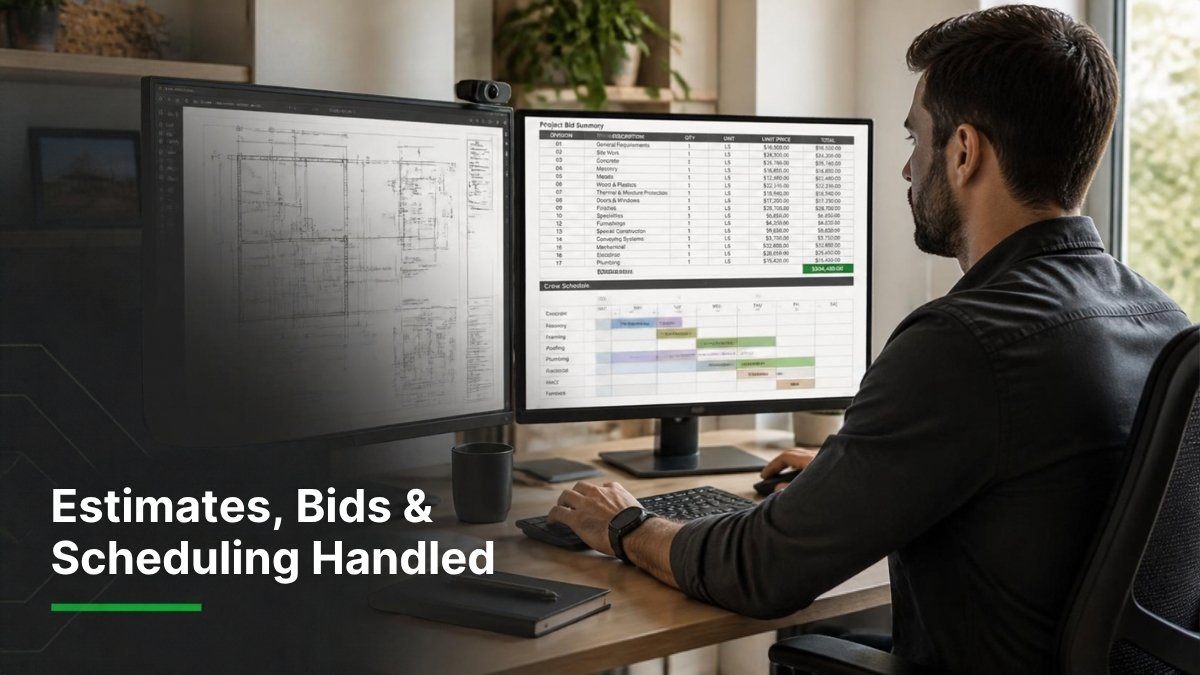
A Professional VA can organize plans and bid documents, enter takeoff quantities, price materials, and build the proposal in your template. Then you review, adjust, and send.
4. Bid tracking and bid invitations
Your VA monitors bid invitations, logs due dates, submits bid packages, and follows up with GCs and owners so nothing slips past a deadline.
5. Crew and subcontractor scheduling
Confirm crews and subs for tomorrow, reschedule when weather hits, and keep homeowners updated on arrival times.
6. Permit applications and inspection tracking
Prepare permit paperwork, track inspection dates, and keep a running list of what is pending with each jurisdiction.
7. Compliance documents
Keep licenses, certificates of insurance, lien waivers, and W-9s organized and current for every sub and supplier, so you are never scrambling before a job starts.
8. Invoicing and change orders
Send invoices the day a phase is complete, document change orders, and attach photos so there are no surprises.
9. Collections and payment reminders
Polite, consistent follow-up on unpaid balances is one of the fastest ways to improve cash flow, and one of the first things owners stop doing when they get busy.
10. Supplier quotes and material orders
Request quotes, place orders, and track deliveries so your crew is not standing around waiting on materials.
11. Project management updates
Keep job boards current in tools like ClickUp, Asana, Monday.com, or Trello. Your VA can also send customers a short weekly progress update.
12. Reviews and project photos
Request a Google review after every completed job and post before-and-after photos to social media. Eventually, this becomes your best marketing.
What Should You Keep Doing Yourself?
A good rule: keep anything that needs your license, your judgment on site, or your relationships. Final pricing decisions, walkthroughs, hiring, and key customer conversations should still stay with you. On the other hand, everything repeatable, like scheduling, follow-up, paperwork, and data entry, is a candidate to delegate.
What Does a Virtual Assistant for Contractors Cost?
At Go Hire Virtual, pricing is published up front:
- General VA, $12/hr: calls, booking site visits, scheduling, data entry, invoicing, and email.
- Professional VA, $14/hr: estimating and takeoff support, bid management, bookkeeping, AP/AR, and marketing.
A full-time General VA (40 hours a week) works out to about $480 a week. There are no recruiting fees and no long-term contracts, so you can add hours during busy season and scale back in winter. In contrast, an in-house office manager also costs you payroll taxes, benefits, equipment, and the time it takes to recruit and train.
Signs You Are Ready to Hire a Virtual Assistant for Contractors
- You regularly miss calls while you are on site.
- Estimates take you more than a few days to send.
- Invoices go out late, or you are not sure who still owes you.
- You do paperwork at night or on weekends.
- You have turned down work because you could not keep up with the office side.
If two or more of those sound familiar, a VA will likely pay for itself quickly because of faster responses and fewer missed jobs.
How to Get Started With a Virtual Assistant for Contractors
- Book a free 15-minute task audit. We map the office work slowing your business down.
- Get matched. We match you with a trained, pre-vetted VA, usually in about one week.
- Start delegating. Your VA works in your tools, while our client success team supports you along the way.
See everything a VA can handle on our construction virtual assistant page. If you run a service trade like HVAC or plumbing, also see our home services virtual assistants.
Frequently Asked Questions
What does a virtual assistant for contractors do?
A virtual assistant for contractors answers calls and leads, schedules crews and subcontractors, supports estimating and bid tracking, prepares permit paperwork, sends invoices, follows up on payments, and keeps project management tools up to date.
Can a virtual assistant for contractors help with estimates?
Yes. A Professional VA can organize plans, enter takeoff quantities, price materials, and build proposals in your template so you only need to review and approve them.
How much does a virtual assistant for contractors cost?
Go Hire Virtual contractor VAs start at $12/hr for general admin and scheduling, and $14/hr for Professional VAs who handle estimating, bids, and bookkeeping. There are also no long-term contracts.
Is a virtual assistant better than hiring an office manager?
For most small and mid-size contractors, a VA covers the same day-to-day office work for a fraction of the cost of an in-house hire, with no payroll taxes, benefits, or equipment, and you can also scale hours up or down with the season.